The Power of Compound Interest: When Does It Really Pay Off?
Compound interest pays off when your capital has time to grow. See how your starting amount, time and rate shape your investment growth.
TL;DR
- Compound interest grows with capital and time. The more you invest and the longer you leave it invested, the greater the potential returns.
- Starting early makes a big difference. Even small investments can grow significantly when given enough time to compound.
- Regular contributions accelerate growth. Adding to your investment consistently increases the amount earning returns.
- Reinvesting is key. Keeping your earnings invested allows them to generate additional returns.
- DPT Earn makes compounding easier. Deposit USDT or USDC, earn variable yields of up to 11% APY through DPT High Yield, and have your returns automatically reinvested.
When does compound interest start making a difference? Simply put, when you have enough money invested and give it enough time to grow. The more you start with, the more you can earn in returns. And the longer you leave your money invested, the more those returns can generate returns of their own. But how much money and how much time does it actually take to see a difference? Let's look at the numbers.
How Does Compound Interest Work?
Compound interest is the interest you earn on the money you saved and the interest it has generated so far. Let’s say you saved $1,000 at an interest rate of 5% per year. After the first year, your interest would be 5% of your $1,000 capital, which comes to $50. In your second year, your capital is now $1,050 (initial capital + first-year interest).
Your second-year interest then comes to $52.50. Now, run the same numbers with $100,000. Your first-year interest is $5,000, and your second-year interest is $5,250. Compounding added $2.50 to the first person’s second year. It added $250 to the second person’s.
When Does Compound Interest Start Making a Difference?
It all boils down to three things: your starting capital, time, and your rate of return. Capital and time matter most; your rate decides how fast it all grows.
Compound Interest Examples: Why Capital and Time Matter
Imagine three people investing $1,000, $10,000, and $100,000 respectively at an interest rate of 10%, compounded annually.
| Starting investment | After 1 year | After 10 years |
|---|---|---|
| $1,000 | $1,100 | $2,594 |
| $10,000 | $11,000 | $25,937 |
| $100,000 | $110,000 | $259,374 |
All three people earn the same 10%. All three wait the same ten years. But the first person makes $1,594 in interest, while the third person makes $159,374. It’s not that compound interest works better for the third person; it’s how much money is working for them.
Time multiplies the effect. Leave the $100,000 at 10% for 20 years instead of 10 and it grows to about $672,750; after 30 years, about $1.74 million. The second decade adds about $413,000, far more than the first decade’s $159,374, because each year’s returns build on a bigger balance.
What Warren Buffett’s Wealth Shows About Compound Interest
To see what happens when a large capital base is given time to compound, consider Warren Buffett’s net worth.
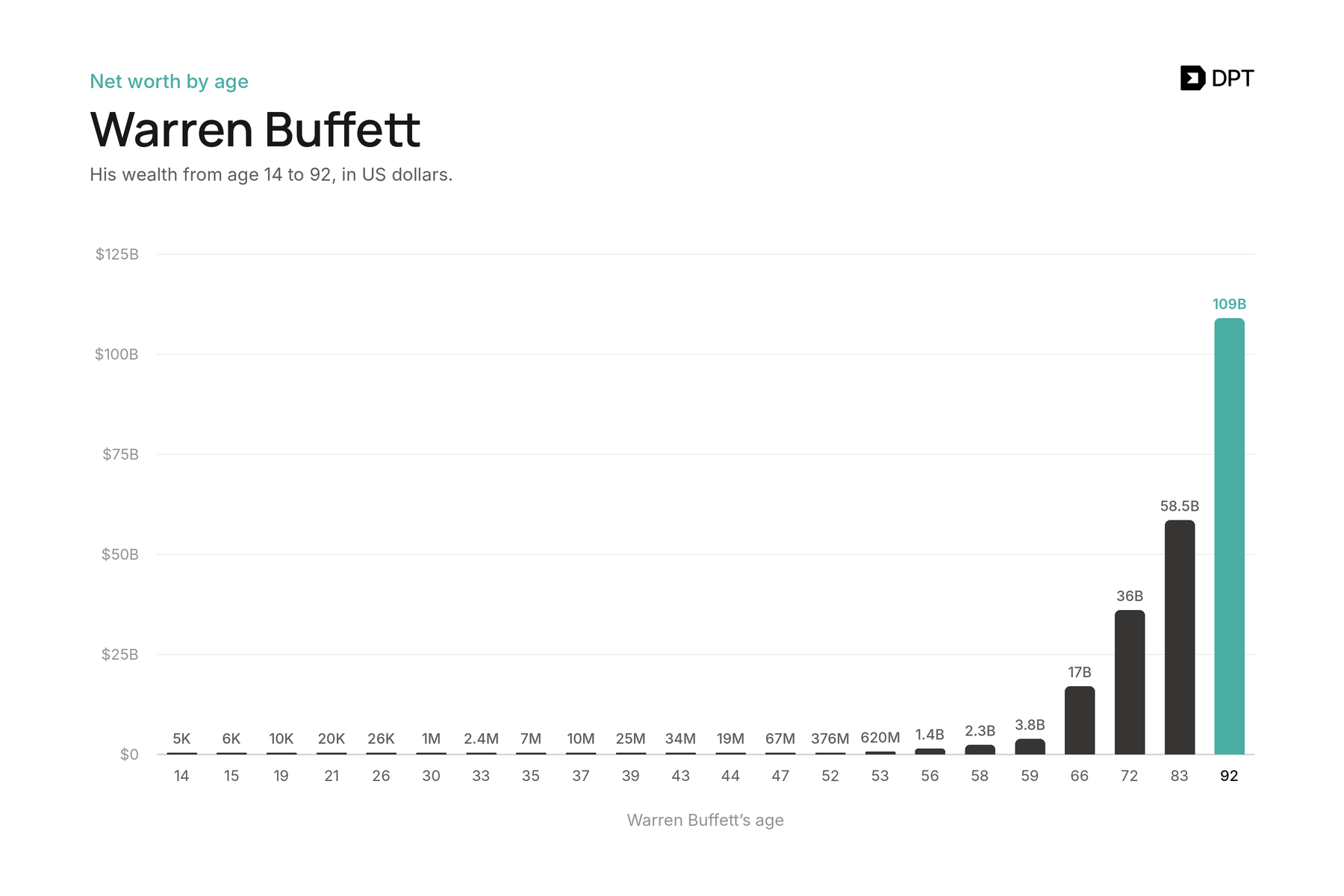
He started investing at age 11, but much of his wealth was built later in life. Between 1965 and 2024, his company, Berkshire Hathaway, recorded an average compounded annual return of 19.9%. Hypothetically, this would grow a $10,000 investment into more than $500 million.
Look at the chart again. The steep part of the curve doesn’t come from a sudden jump in his returns. It comes from decades of reinvested returns working on a capital base that kept growing. 19.9% on $1,000 for ten years gives you about $6,140. 19.9% on $1,000,000 for the same ten years gives you about $6.1 million.
Of course, Buffett’s returns are exceptional, but the principle applies to everyone: the larger your capital and the longer it stays invested, with the returns reinvested, the more compounding has to work with.
How to Make Compound Growth Work for You
Since capital and time decide how much compounding can do for you, the goal is simple: build a substantial capital base, start as early as you can, keep adding to it, and leave it to grow.
Start With as Much as You Can Afford
Start with the largest amount you can comfortably afford, because a bigger amount does a lot more work. $500 invested at 7% annual returns will grow into approximately $1,935 over 20 years with no extra addition. $25,000 invested the same way grows into approximately $96,742.
Before committing to a long-term investment, make sure you can afford your daily expenses and have built up an emergency fund.
Start Early
David starts investing $200 monthly from age 25 to 65. Jeremy starts the same amount at 35. If both earn 7% a year, compounded monthly, David ends up with $524,963 and Jeremy with $243,994. By 35, David has already built about $34,617, and that head start in capital keeps compounding for another 30 years. Those ten extra years more than doubled David’s final balance.
Make Regular Contributions
Starting early gives your money time to grow; adding to it regularly grows your capital. If you invest $1,000 at an annual interest rate of 7%, compounded monthly, after 20 years:
| Investment strategy | Approximate value |
|---|---|
| $1,000 invested once | $4,039 |
| $1,000 initially + $50 monthly | $30,085 |
| $1,000 initially + $100 monthly | $56,131 |
| $1,000 initially + $200 monthly | $108,223 |
Figures from a compound interest calculator. Assumes contributions are made at the end of each month, with no fees or taxes.
Now, compare that with starting with a larger amount. If you invested $25,000 at the same 7% annual return, compounded monthly, and made no additional contributions, you'd have about $100,968 after 20 years. That's not far from the $108,223 you'd get by starting with $1,000 and adding $200 every month. The difference? With the monthly contributions, you'd have invested $49,000 of your own money, compared to just $25,000 with the larger upfront investment. A large starting amount does nearly the same job with about half the money.
Reinvest Your Earnings
Reinvesting earnings is what keeps compounding going. Every dollar of profit you leave invested becomes part of your capital and starts earning returns of its own. Taking out your profit at intervals defeats the whole purpose of compound growth.
That’s one thing DPT Earn handles for you. Your yield is reinvested automatically, so your whole balance keeps compounding without extra steps.
Grow Your Capital With DPT Earn
If you’re looking to earn returns without dealing with complicated processes or managing DeFi positions, DPT Pay offers a straightforward approach through DPT Earn.
To earn USDT yield or USDC yield, you simply deposit your stablecoins into DPT’s High Yield vault, powered by OnRe. This is where your rate comes in, and where DPT Earn stands out: it offers an 11% APY on your stablecoins, though this rate could vary over time.
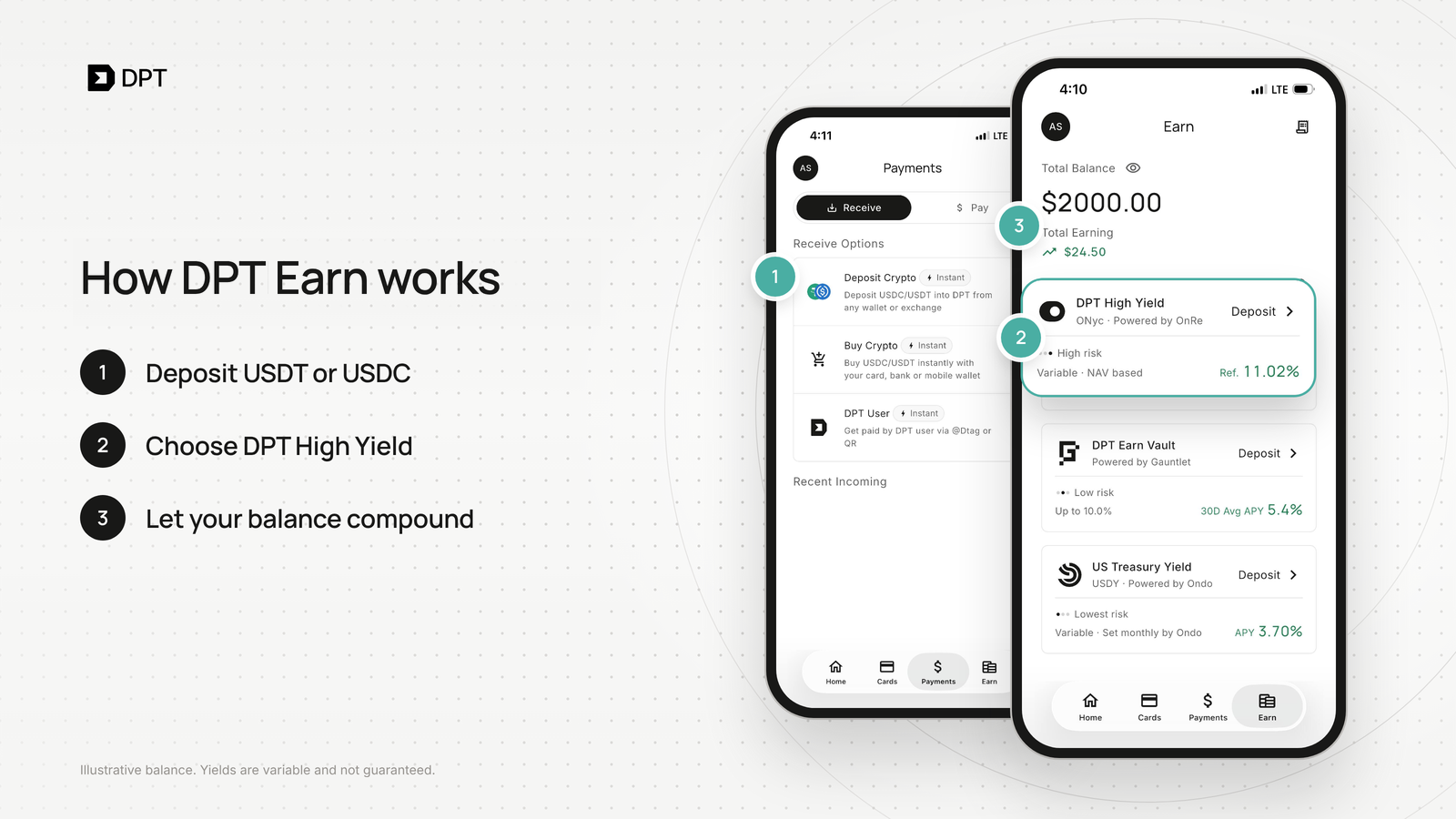
At an 11% APY, assuming the rate holds and there are no fees or losses, after five years:
- $10,000 could grow to about $16,851, earning about $6,851.
- $50,000 could grow to about $84,253, earning about $34,253.
- $100,000 could grow to about $168,506, earning about $68,506.
Give it ten years and the same $100,000 could reach about $283,942. That’s time and rate working together on your capital.
You can withdraw your funds at any time or use Spend from Earn to cover card payments when your spending balance runs low.
How DPT Earn Generates Yield (and the Risks)
DPT Earn is built on trusted financial infrastructure, with products powered by established providers. Our U.S. Treasury product is backed by Ondo, Earn Vault is powered by Gauntlet, and High Yield by OnRe, a licensed reinsurer regulated in Bermuda.
Your funds are held in wallets powered by Privy, Stripe's Web3 wallet infrastructure, and can only be moved on your instructions. While no investment is entirely risk-free, these partnerships help us manage risks and keep your funds secure.
Ready to give your capital time to compound? Deposit USDT or USDC into DPT Earn and let your returns compound automatically.
*Disclaimer: This article is for educational purposes only and does not constitute financial, investment, legal or tax advice, or a recommendation to buy, sell or hold any asset or to use any particular product. All figures and examples are hypothetical, are provided for illustration only and do not account for fees, taxes or your personal circumstances. Interest rates and yields, including those offered through DPT Pay Earn, are variable and not guaranteed, and past performance is not a reliable indicator of future results. Digital assets, including stablecoins, carry risk, and you could lose some or all of the money you deposit. *